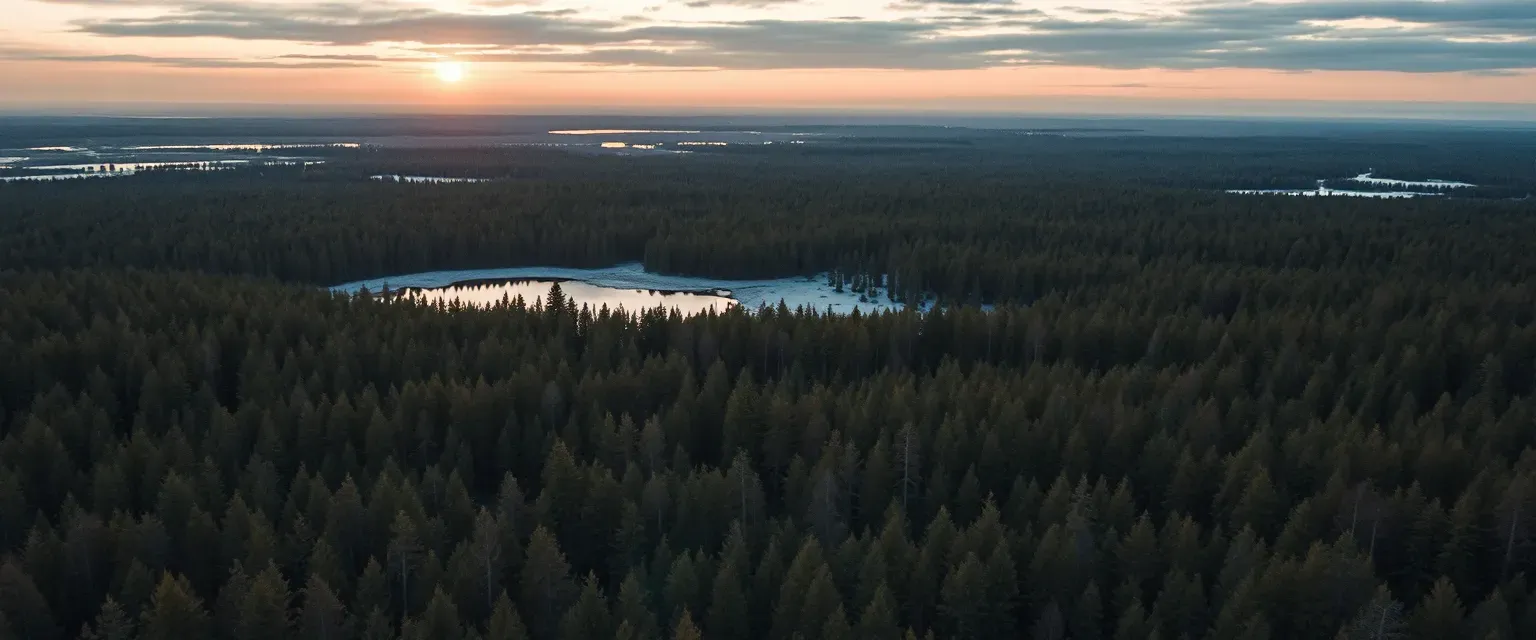
 Generated, not a photograph
Palearctic · Boreal Forests/Taiga
Scandinavian and Russian taiga
Generated imagery, not footage of this place.
Scandinavian and Russian taiga lies in the Boreal Forests/Taiga biome of the Palearctic realm.1 The region covers about 2,200,000 square kilometres (850,000 square miles), mainly within Russia, Finland and Sweden.1, 3
Ground
At 40 random points, land elevation ranges from 43 to 527 metres, with a median of 147. SoilGrids identifies Albeluvisols as the most likely soil group at 3 of 5 sampled points.4, 5
Water
Natural Earth maps the Pechora, Vychegda, and Mezen rivers through the region. Lake Saimaa and Rybinsk Reservoir are within its bounds; NASA POWER models 860 millimetres of annual precipitation at the region's centre, peaking in August and lowest in February.3, 6
Air and sky
NASA POWER records a mean annual temperature of 1.3 degrees Celsius at the region's centre, ranging from -13.1 in January to 16.5 in July. Cloud cover averages 75 percent, and relative humidity at two metres is 92 percent.6
State of the land
RESOLVE classes the region "Nature Could Recover": natural habitat remaining plus protected area sums to between 20 and 50 percent of the region; OpenStreetMap records Национальный парк «Югыд Ва», Национальный парк «Русский Север» and Blåfjella-Skjækerfjella nasjonalpark among its national-park-class protected areas with land within it.1, 2, 7
Living layer
Recorded inside the region by field observers since 2015.8, 9
| Species | Group | IUCN Red List |
|---|---|---|
| Vaccinium vitis-idaeaCowberry | Plant | Least Concern |
| Vaccinium myrtillusBilberry | Plant | No category recorded |
| Parus majorGreat Tit | Bird | Least Concern |
| Cyanistes caeruleusEurasian Blue Tit | Bird | Least Concern |
| Pteromys volansSiberian Flying Squirrel | Mammal | Least Concern |
| Rana arvalisMoor Frog | Amphibian | Least Concern |
 Generated, not a photograph
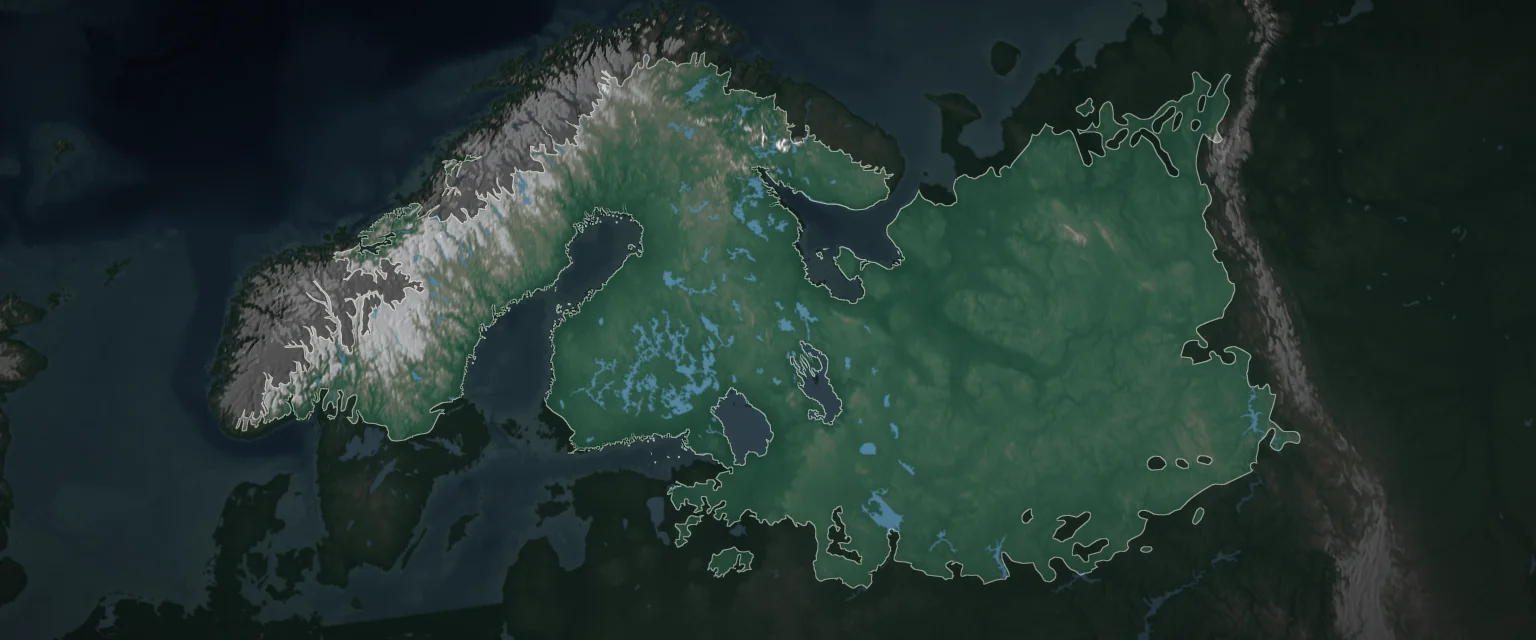 Generated, not a photograph
Follow Scandinavian and Russian taiga
Leave your email and we will tell you when Scandinavian and Russian taiga is updated. That is all we will write about.
Your address goes into our own database and nowhere else: no mailing-list company, no analytics, no advertiser. We do not record where you are. Ecoregions is for people 18 and over. To have it removed, write to joshuakloss@gmail.com. More in the privacy page.
Sources
- 1Dinerstein et al. 2017, Ecoregions2017 (RESOLVE), CC BY 4.0 https://doi.org/10.1093/biosci/bix014
- 2Dinerstein et al. 2017, BioScience 67(6):534-545, Nature Needs Half categories https://www.ncbi.nlm.nih.gov/pmc/articles/PMC5451287/
- 3Natural Earth 1:10m rivers, lakes and countries (public domain) https://www.naturalearthdata.com/
- 4AWS Terrain Tiles (Mapzen/Tilezen joerd; USGS 3DEP, SRTM, GEBCO and others) https://github.com/tilezen/joerd/blob/master/docs/attribution.md Elevation: AWS Terrain Tiles (Mapzen/Tilezen joerd), composed from USGS 3DEP, NASA SRTM, GEBCO and other open elevation data.
- 5ISRIC SoilGrids 2.0, WRB classification, CC BY 4.0 https://rest.isric.org/soilgrids/v2.0/docs Cite as Poggio et al. (2021), in the journal SOIL.
- 6NASA POWER monthly climatology 2001-2025 (modelled at a point) https://power.larc.nasa.gov/docs/services/api/temporal/climatology/ NASA POWER climatology 2001–2025, fetched 10 Oct 2026 (API version not recorded; v2.10.1 when checked on 25 Oct).
- 7OpenStreetMap contributors, ODbL (national-park ways and relations) https://www.openstreetmap.org/copyright
- 8GBIF occurrence and species API (human observations 2015-2026) https://www.gbif.org/developer/occurrence
- 9IUCN Red List category as served by the GBIF species API https://www.gbif.org/developer/species
Each fact was made by code from the sources listed, then re-checked by a second script written by the same maker; 13 of 24 were re-asked from the live source, 2 of those at only some of their points. No scientist has reviewed this page yet. Checked 2026-10-16; the elevation figures were re-read 2026-11-08. Some sentences were worded by a language model running on the maker's computer, from these claims. A script rejected any wording that added a number or a name, and the same model compared each sentence with its claims; no person has read them.
Found a mistake? Tell us; a correction beats a guess.