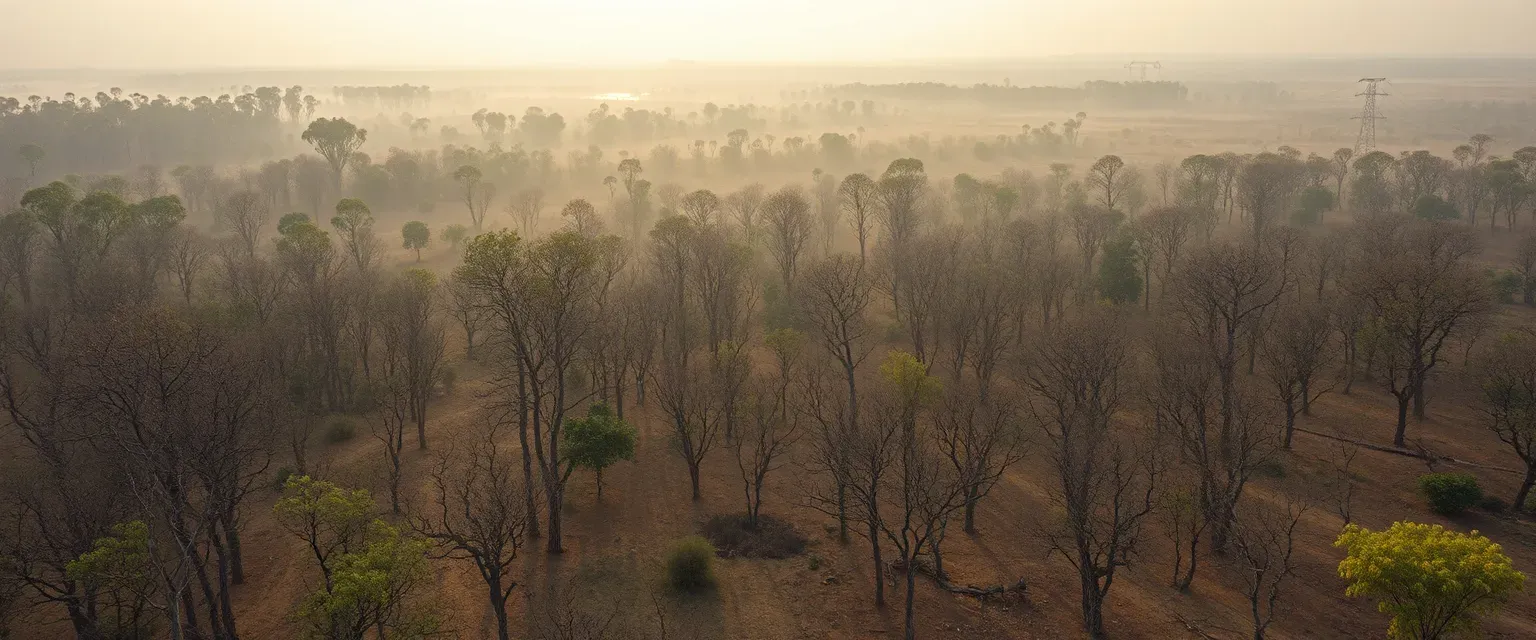
 Generated, not a photograph
Indomalayan · Tropical & Subtropical Dry Broadleaf Forests
Khathiar-Gir dry deciduous forests
Generated imagery, not footage of this place.
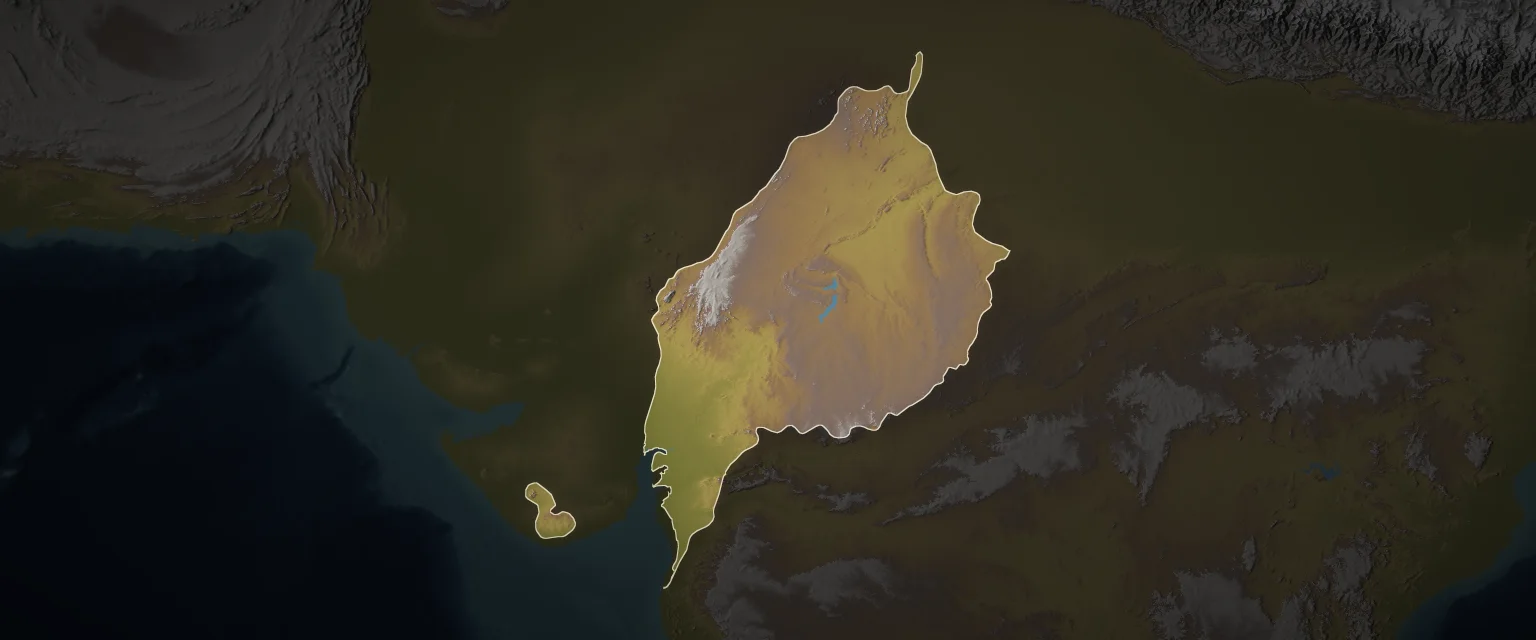
Khathiar-Gir dry deciduous forests lies in the Tropical & Subtropical Dry Broadleaf Forests biome of the Indomalayan realm.1 The region spans about 270,000 square kilometres (100,000 square miles) within India.1, 3
Ground
At 40 random points, the land ranges from 24 to 815 metres, with a median of 404; SoilGrids identifies Vertisols as the most likely soil group at two of three sampled points.4, 5
Water
Natural Earth traces the courses of Chambal, Banas and Mahi through it; Gandhi Sagar Dam lies within its bounds; NASA POWER models about 780 millimetres of precipitation a year at the region's centre, most in August and least in December.3, 6
Air and sky
At the region’s centre, NASA POWER reports a mean annual temperature of 25.4 degrees Celsius, ranging from 16.5 in January to 34.2 in May; clouds cover 39 percent of the sky on average, and relative humidity at two metres is 48 percent.6
State of the land
RESOLVE classes the region "Nature Imperiled": natural habitat remaining plus protected area sums to 20 percent or less of the region; OpenStreetMap records Ranthambhore National Park, Madhav National Park and Sariska National Park among its national-park-class protected areas with land within it.1, 2, 7
Living layer
Recorded inside the region by field observers since 2015.8, 9
| Species | Group | IUCN Red List |
|---|---|---|
| Holoptelea integrifoliaIndian-elm | Plant | Least Concern |
| Cinnyris asiaticusPurple Sunbird | Bird | Least Concern |
| Turdoides striataJungle Babbler | Bird | Least Concern |
| Orthotomus sutoriusCommon Tailorbird | Bird | Least Concern |
| Merops orientalisGreen Bee-eater | Bird | Least Concern |
| Ortygornis pondicerianusGrey Francolin | Bird | Least Concern |
 Generated, not a photograph
 Generated, not a photograph
Follow Khathiar-Gir dry deciduous forests
Leave your email and we will tell you when Khathiar-Gir dry deciduous forests is updated. That is all we will write about.
Your address goes into our own database and nowhere else: no mailing-list company, no analytics, no advertiser. We do not record where you are. Ecoregions is for people 18 and over. To have it removed, write to joshuakloss@gmail.com. More in the privacy page.
Sources
- 1Dinerstein et al. 2017, Ecoregions2017 (RESOLVE), CC BY 4.0 https://doi.org/10.1093/biosci/bix014
- 2Dinerstein et al. 2017, BioScience 67(6):534-545, Nature Needs Half categories https://www.ncbi.nlm.nih.gov/pmc/articles/PMC5451287/
- 3Natural Earth 1:10m rivers, lakes and countries (public domain) https://www.naturalearthdata.com/
- 4AWS Terrain Tiles (Mapzen/Tilezen joerd; USGS 3DEP, SRTM, GEBCO and others) https://github.com/tilezen/joerd/blob/master/docs/attribution.md Elevation: AWS Terrain Tiles (Mapzen/Tilezen joerd), composed from USGS 3DEP, NASA SRTM, GEBCO and other open elevation data.
- 5ISRIC SoilGrids 2.0, WRB classification, CC BY 4.0 https://rest.isric.org/soilgrids/v2.0/docs Cite as Poggio et al. (2021), in the journal SOIL.
- 6NASA POWER monthly climatology 2001-2025 (modelled at a point) https://power.larc.nasa.gov/docs/services/api/temporal/climatology/ NASA POWER climatology 2001–2025, fetched 10 Oct 2026 (API version not recorded; v2.10.1 when checked on 25 Oct).
- 7OpenStreetMap contributors, ODbL (national-park ways and relations) https://www.openstreetmap.org/copyright
- 8GBIF occurrence and species API (human observations 2015-2026) https://www.gbif.org/developer/occurrence
- 9IUCN Red List category as served by the GBIF species API https://www.gbif.org/developer/species
Each fact was made by code from the sources listed, then re-checked by a second script written by the same maker; 14 of 25 were re-asked from the live source, 2 of those at only some of their points. No scientist has reviewed this page yet. Checked 2026-10-12; the elevation figures were re-read 2026-11-08. Some sentences were worded by a language model running on the maker's computer, from these claims. A script rejected any wording that added a number or a name, and the same model compared each sentence with its claims; no person has read them.
Found a mistake? Tell us; a correction beats a guess.