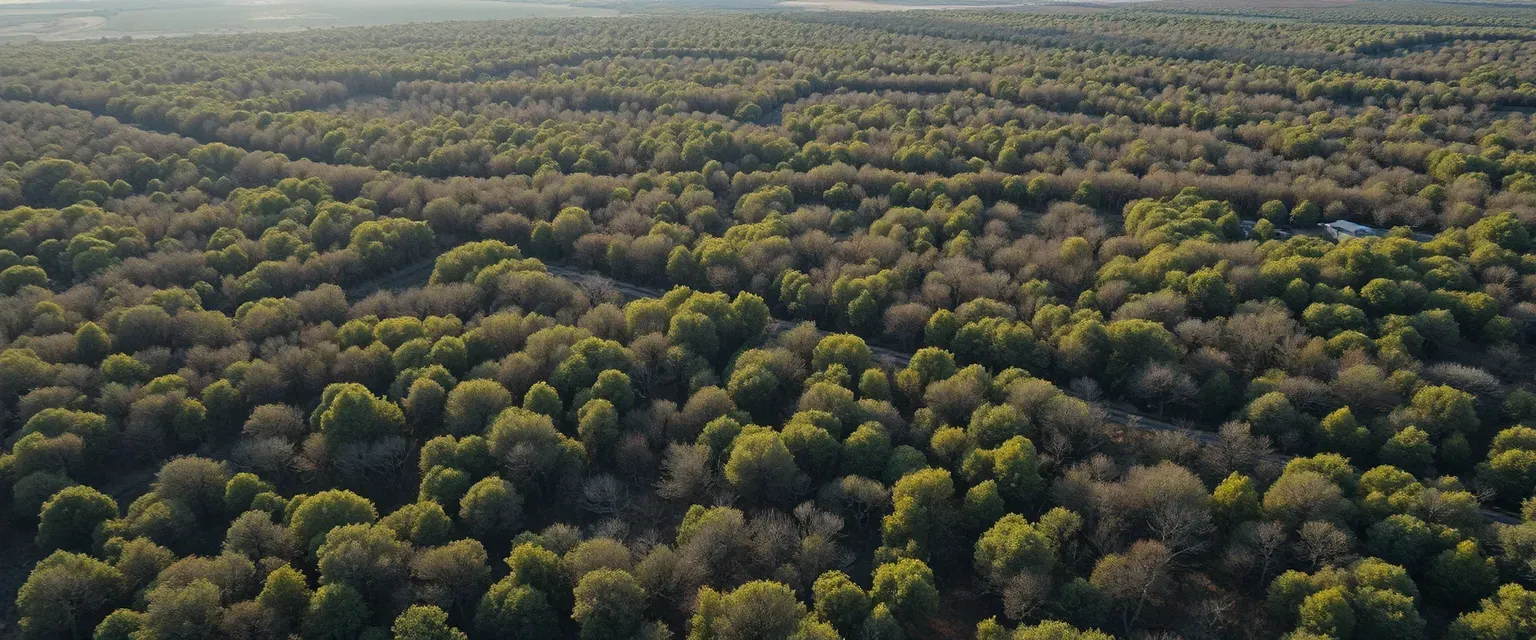
 Generated, not a photograph
Palearctic · Mediterranean Forests, Woodlands & Scrub
Iberian sclerophyllous and semi-deciduous forests
Generated imagery, not footage of this place.
Iberian sclerophyllous and semi-deciduous forests lies in the Mediterranean Forests, Woodlands & Scrub biome of the Palearctic realm.1 The region covers about 300,000 square kilometres (120,000 square miles), within Spain and Portugal.1, 3
Ground
SoilGrids identifies Cambisols as the most likely soil group at all five sampled points.4
Water
Natural Earth traces the courses of Guadiana, Duero and Tajo through it; Embalse de Buendía lies within its bounds; NASA POWER models about 370 millimetres of precipitation a year at the region's centre, most in October and least in July.3, 5
Air and sky
At the region's centre, NASA POWER records a mean annual temperature of 14.8 degrees Celsius, ranging from 4.8 in January to 26.7 in July; cloud covers 45 percent of the sky on average and relative humidity at two metres is 61 percent.5
State of the land
RESOLVE classes the region "Nature Could Recover": natural habitat remaining plus protected area sums to between 20 and 50 percent of the region; OpenStreetMap records Parque Nacional de Monfragüe, Parque Natural de las Lagunas de La Mata y Torrevieja and Parque nacional de las Tablas de Daimiel among its national-park-class protected areas with land within it.1, 2, 6
Living layer
Recorded inside the region by field observers since 2015.7, 8
| Species | Group | IUCN Red List |
|---|---|---|
| Quercus rotundifoliaBallota oak | Plant | Least Concern |
| Juniperus oxycedrusCade Juniper | Plant | No category recorded |
| Turdus merulaEurasian Blackbird | Bird | Least Concern |
| Hirundo rusticaBarn Swallow | Bird | Least Concern |
| Lutra lutraEuropean otter | Mammal | Near Threatened |
| Epidalea calamitaNatterjack | Amphibian | Least Concern |
 Generated, not a photograph
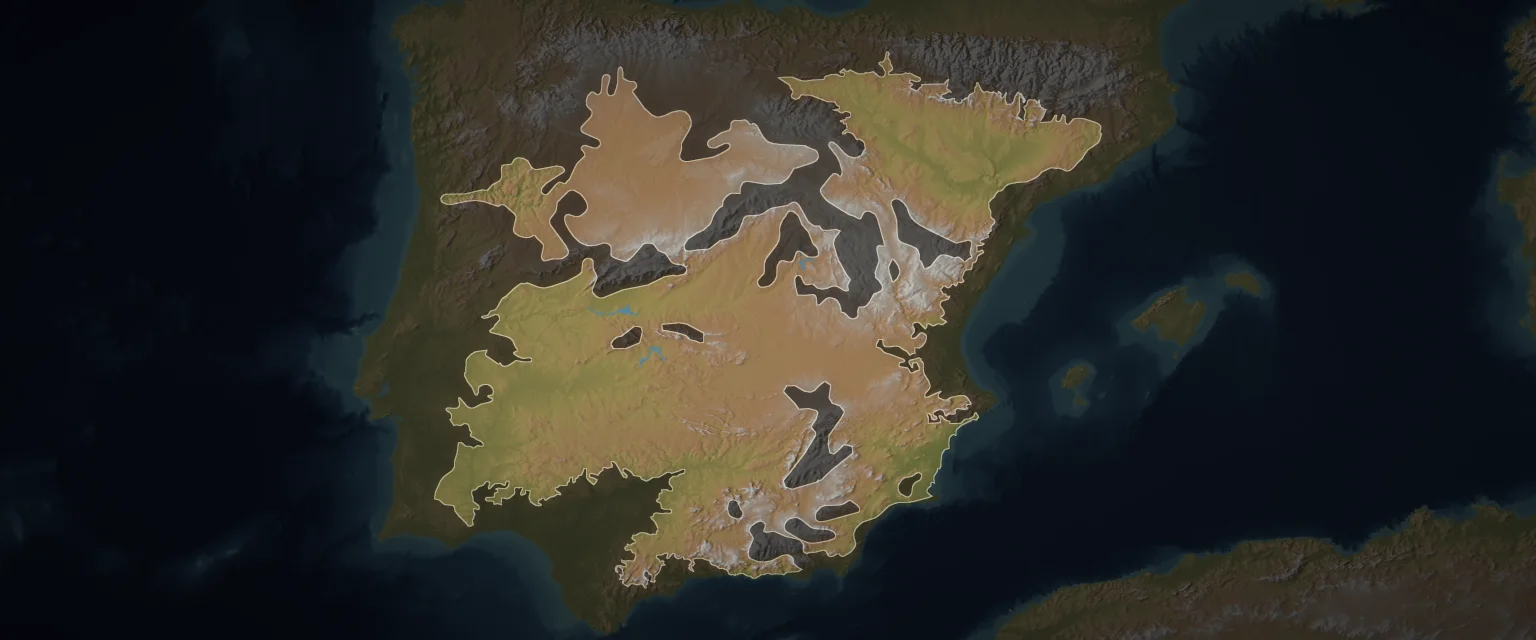 Generated, not a photograph
Follow Iberian sclerophyllous and semi-deciduous forests
Leave your email and we will tell you when Iberian sclerophyllous and semi-deciduous forests is updated. That is all we will write about.
Your address goes into our own database and nowhere else: no mailing-list company, no analytics, no advertiser. We do not record where you are. Ecoregions is for people 18 and over. To have it removed, write to joshuakloss@gmail.com. More in the privacy page.
Sources
- 1Dinerstein et al. 2017, Ecoregions2017 (RESOLVE), CC BY 4.0 https://doi.org/10.1093/biosci/bix014
- 2Dinerstein et al. 2017, BioScience 67(6):534-545, Nature Needs Half categories https://www.ncbi.nlm.nih.gov/pmc/articles/PMC5451287/
- 3Natural Earth 1:10m rivers, lakes and countries (public domain) https://www.naturalearthdata.com/
- 4ISRIC SoilGrids 2.0, WRB classification, CC BY 4.0 https://rest.isric.org/soilgrids/v2.0/docs Cite as Poggio et al. (2021), in the journal SOIL.
- 5NASA POWER monthly climatology 2001-2025 (modelled at a point) https://power.larc.nasa.gov/docs/services/api/temporal/climatology/ NASA POWER climatology 2001–2025, fetched 10 Oct 2026 (API version not recorded; v2.10.1 when checked on 25 Oct).
- 6OpenStreetMap contributors, ODbL (national-park ways and relations) https://www.openstreetmap.org/copyright
- 7GBIF occurrence and species API (human observations 2015-2026) https://www.gbif.org/developer/occurrence
- 8IUCN Red List category as served by the GBIF species API https://www.gbif.org/developer/species
Each fact was made by code from the sources listed, then re-checked by a second script written by the same maker; 12 of 23 were re-asked from the live source, 1 of those at only some of their points. No scientist has reviewed this page yet. Checked 2026-10-13. Some sentences were worded by a language model running on the maker's computer, from these claims. A script rejected any wording that added a number or a name, and the same model compared each sentence with its claims; no person has read them.
Found a mistake? Tell us; a correction beats a guess.