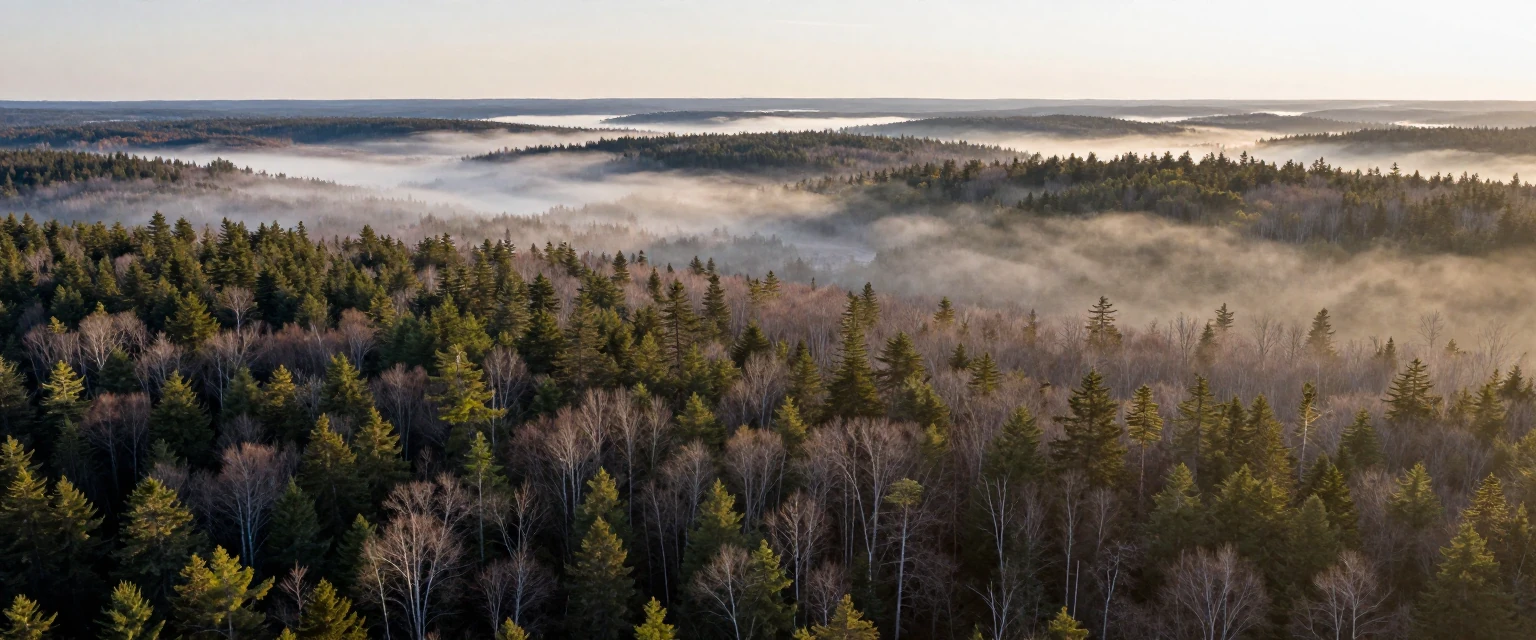
 Generated, not a photograph
Nearctic · Temperate Broadleaf & Mixed Forests
Gulf of St. Lawrence lowland forests
Generated imagery, not footage of this place.
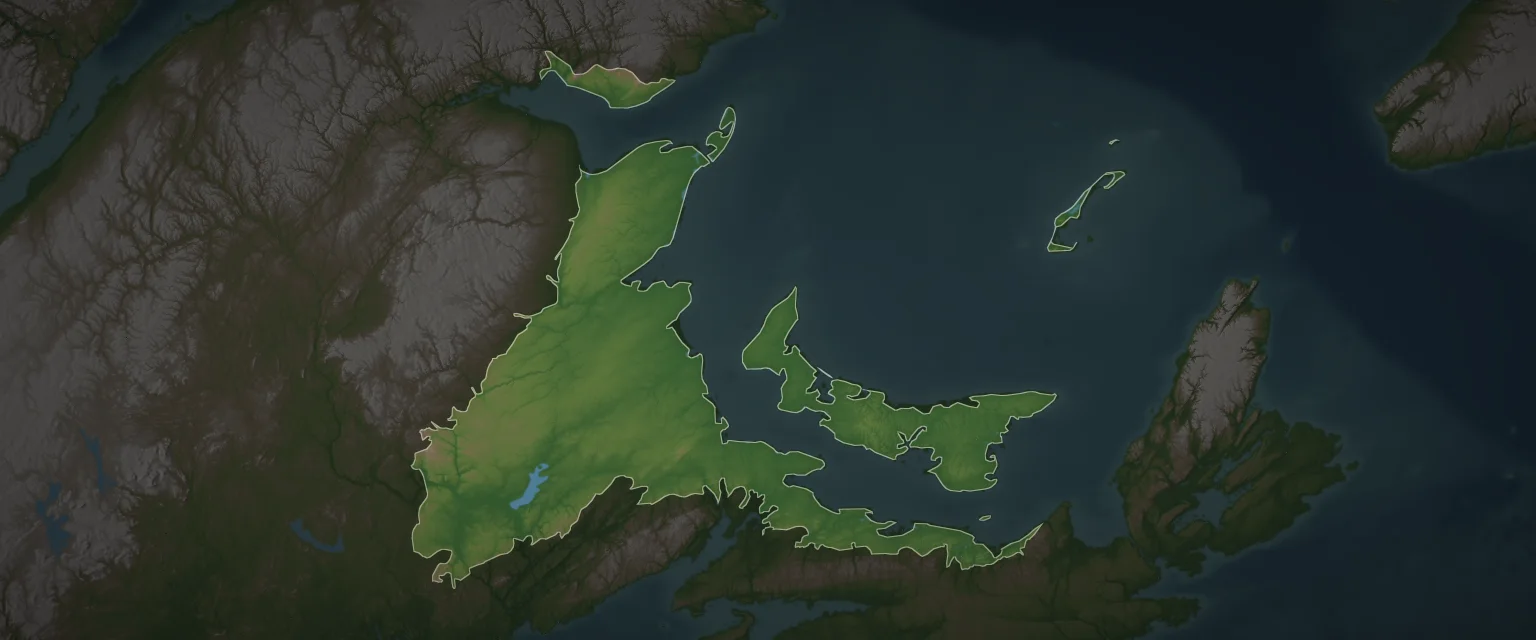
Gulf of St. Lawrence lowland forests lies in the Temperate Broadleaf & Mixed Forests biome of the Nearctic realm.1 The region covers about 36,000 square kilometres (14,000 square miles), mainly within Canada.1, 3
Ground
SoilGrids identifies Podzols as the most likely soil group at all four sampled points.4
Water
Natural Earth traces the courses of Miramichi and Saint John through it; Grand Lake lies within its bounds; NASA POWER models about 950 millimetres of precipitation a year at the region's centre, most in June and October, about equal and least in February and January, about equal.3, 5
Air and sky
NASA POWER reports a mean annual temperature of 5.7 degrees Celsius at the region's centre, ranging from -8.6 in January to 19.2 in July; cloud cover averages 67 percent and relative humidity at two metres is 84 percent.5
State of the land
RESOLVE classes the region "Nature Could Reach Half Protected": less than half of the region is protected, but protected area plus remaining natural habitat sums to more than half; OpenStreetMap records Grand Lake Protected Natural Area, Parc national de Kouchibouguac and Zone naturelle protégée du Rivière Black among its national-park-class protected areas with land within it.1, 2, 6
Living layer
Recorded inside the region by field observers since 2015.7, 8
| Species | Group | IUCN Red List |
|---|---|---|
| Clintonia borealisBluebead | Plant | No category recorded |
| Cypripedium acauleLady's-Slipper Orchid | Plant | Least Concern |
| Zenaida macrouraMourning Dove | Bird | Least Concern |
| Corvus coraxCommon Raven | Bird | Least Concern |
| Lepus americanussnowshoe hare | Mammal | Least Concern |
| Lithobates pipiensNorthern Leopard Frog | Amphibian | Least Concern |
 Generated, not a photograph
 Generated, not a photograph
Follow Gulf of St. Lawrence lowland forests
Leave your email and we will tell you when Gulf of St. Lawrence lowland forests is updated. That is all we will write about.
Your address goes into our own database and nowhere else: no mailing-list company, no analytics, no advertiser. We do not record where you are. Ecoregions is for people 18 and over. To have it removed, write to joshuakloss@gmail.com. More in the privacy page.
Sources
- 1Dinerstein et al. 2017, Ecoregions2017 (RESOLVE), CC BY 4.0 https://doi.org/10.1093/biosci/bix014
- 2Dinerstein et al. 2017, BioScience 67(6):534-545, Nature Needs Half categories https://www.ncbi.nlm.nih.gov/pmc/articles/PMC5451287/
- 3Natural Earth 1:10m rivers, lakes and countries (public domain) https://www.naturalearthdata.com/
- 4ISRIC SoilGrids 2.0, WRB classification, CC BY 4.0 https://rest.isric.org/soilgrids/v2.0/docs Cite as Poggio et al. (2021), in the journal SOIL.
- 5NASA POWER monthly climatology 2001-2025 (modelled at a point) https://power.larc.nasa.gov/docs/services/api/temporal/climatology/ NASA POWER climatology 2001–2025, fetched 10 Oct 2026 (API version not recorded; v2.10.1 when checked on 25 Oct).
- 6OpenStreetMap contributors, ODbL (national-park ways and relations) https://www.openstreetmap.org/copyright
- 7GBIF occurrence and species API (human observations 2015-2026) https://www.gbif.org/developer/occurrence
- 8IUCN Red List category as served by the GBIF species API https://www.gbif.org/developer/species
Each fact was made by code from the sources listed, then re-checked by a second script written by the same maker; 12 of 23 were re-asked from the live source, 1 of those at only some of their points. No scientist has reviewed this page yet. Checked 2026-10-13. Some sentences were worded by a language model running on the maker's computer, from these claims. A script rejected any wording that added a number or a name, and the same model compared each sentence with its claims; no person has read them.
Found a mistake? Tell us; a correction beats a guess.