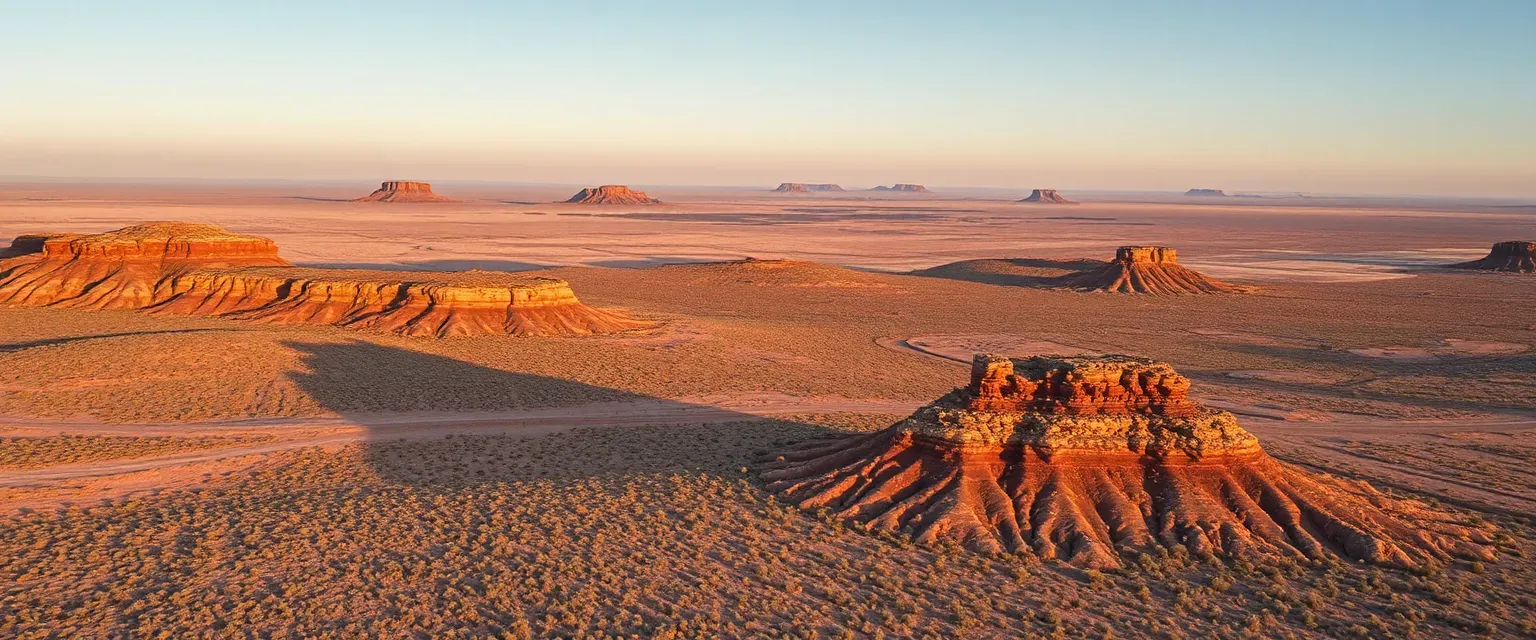
 Generated, not a photograph
Afrotropic · Deserts & Xeric Shrublands
Gariep Karoo
Generated imagery, not footage of this place.
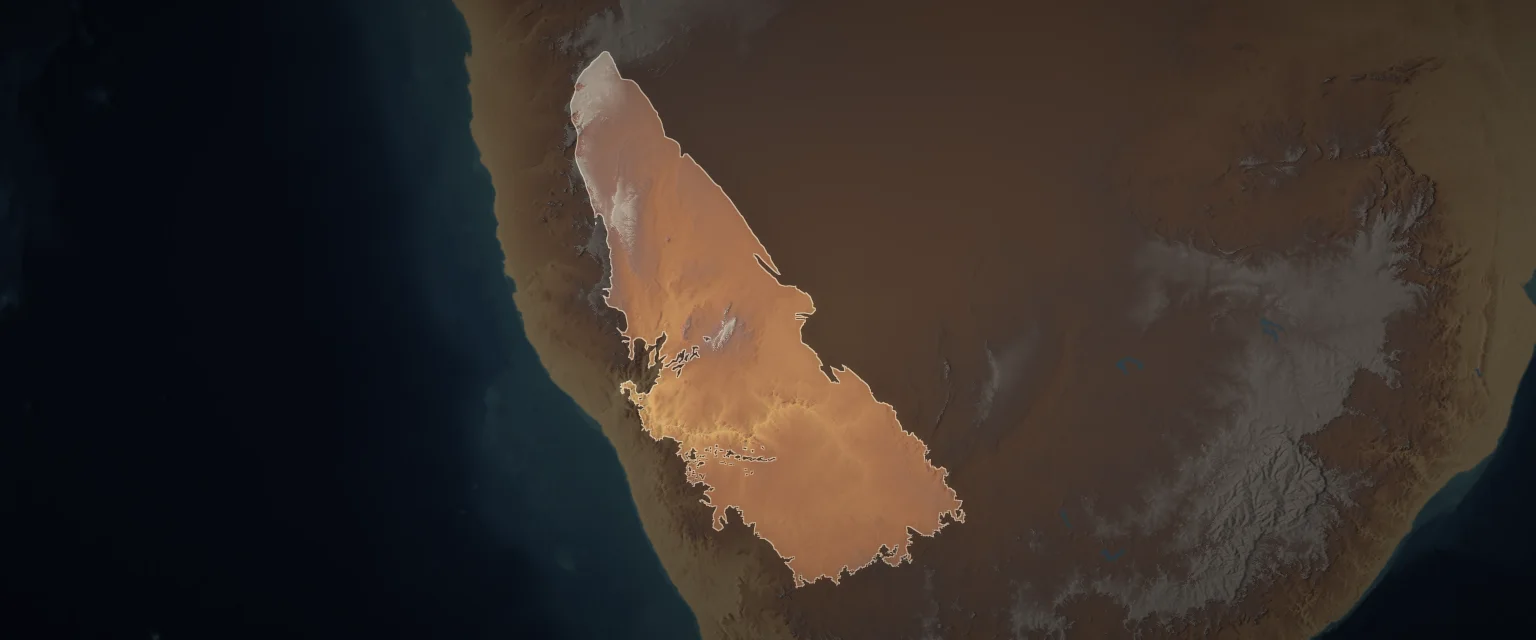
Gariep Karoo lies in the Deserts & Xeric Shrublands biome of the Afrotropic realm.1 The region spans about 250,000 square kilometres (97,000 square miles), within Namibia and South Africa.1, 3
Ground
SoilGrids identifies Cambisols as the most probable soil group at three of five sampled points.4
Water
Natural Earth traces the courses of Orange, Auob and Molopo through it; NASA POWER models about 200 millimetres of precipitation a year at the region's centre, most in March and least in July and August, about equal.3, 5
Air and sky
At the region's centre, NASA POWER reports a mean annual temperature of 20.6 degrees Celsius, ranging from 12.3 in July to 27.7 in January; cloud covers 33 percent of the sky on average, and relative humidity at two metres is 35 percent.5
State of the land
RESOLVE classes the region "Nature Could Reach Half Protected": less than half of the region is protected, but protected area plus remaining natural habitat sums to more than half; OpenStreetMap records Meerkat National Park and Augrabies Falls National Park among its national-park-class protected areas with land within it.1, 2, 6
Living layer
Recorded inside the region by field observers since 2015.7, 8
| Species | Group | IUCN Red List |
|---|---|---|
| Aloidendron dichotomumquiver tree | Plant | Vulnerable |
| Senegalia melliferahookthorn | Plant | Least Concern |
| Passer melanurusCape Sparrow | Bird | Least Concern |
| Philetairus sociusSocial Weaver | Bird | Least Concern |
| Procavia capensisCape hyrax | Mammal | Least Concern |
| Sclerophrys capensisCape Toad | Amphibian | Least Concern |
Points of fact
- The quiver tree (Aloidendron dichotomum) is listed as Vulnerable by the IUCN Red List, via GBIF, and has been observed in the region since 2015.8
 Generated, not a photograph
 Generated, not a photograph
Follow Gariep Karoo
Leave your email and we will tell you when Gariep Karoo is updated. That is all we will write about.
Your address goes into our own database and nowhere else: no mailing-list company, no analytics, no advertiser. We do not record where you are. Ecoregions is for people 18 and over. To have it removed, write to joshuakloss@gmail.com. More in the privacy page.
Sources
- 1Dinerstein et al. 2017, Ecoregions2017 (RESOLVE), CC BY 4.0 https://doi.org/10.1093/biosci/bix014
- 2Dinerstein et al. 2017, BioScience 67(6):534-545, Nature Needs Half categories https://www.ncbi.nlm.nih.gov/pmc/articles/PMC5451287/
- 3Natural Earth 1:10m rivers, lakes and countries (public domain) https://www.naturalearthdata.com/
- 4ISRIC SoilGrids 2.0, WRB classification, CC BY 4.0 https://rest.isric.org/soilgrids/v2.0/docs Cite as Poggio et al. (2021), in the journal SOIL.
- 5NASA POWER monthly climatology 2001-2025 (modelled at a point) https://power.larc.nasa.gov/docs/services/api/temporal/climatology/ NASA POWER climatology 2001–2025, fetched 10 Oct 2026 (API version not recorded; v2.10.1 when checked on 25 Oct).
- 6OpenStreetMap contributors, ODbL (national-park ways and relations) https://www.openstreetmap.org/copyright
- 7GBIF occurrence and species API (human observations 2015-2026) https://www.gbif.org/developer/occurrence
- 8IUCN Red List category as served by the GBIF species API https://www.gbif.org/developer/species
Each fact was made by code from the sources listed, then re-checked by a second script written by the same maker; 14 of 24 were re-asked from the live source, 1 of those at only some of their points. No scientist has reviewed this page yet. Checked 2026-10-13. Some sentences were worded by a language model running on the maker's computer, from these claims. A script rejected any wording that added a number or a name, and the same model compared each sentence with its claims; no person has read them.
Found a mistake? Tell us; a correction beats a guess.